AI recruitment guide (2026): hiring with AI + humans
Hiring has changed more in the last three years than in the twenty before them. AI now writes the job description, finds people who never applied, screens the first hundred CVs and books the interviews. What it does not do is decide who you hire.


Ready to hire smarter?
See how a hire runs at GloPros, from brief to signed contract, and what the AI-platform shows you along the way.
Key takeaways
- AI recruitment automates the vacancy, sourcing, matching, screening, scheduling and admin. People keep the judgment and the decision.
- AI will not replace recruiters. It removes the volume work and raises the stakes on the judgment work.
- The EU AI Act classifies recruitment AI as high-risk. Its high-risk obligations apply from December 2, 2027. Human oversight is mandatory.
- Anonymized, skills-based matching can reduce bias. AI trained on past hiring decisions reproduces it.
- The buying question is no longer "which software" but "tools, agency or service." The right answer depends on volume, team and how much of the work you want to own.
- Start with the step that costs your team the most hours, usually screening or scheduling, and keep a person reviewing the shortlist, the rejection and the offer.
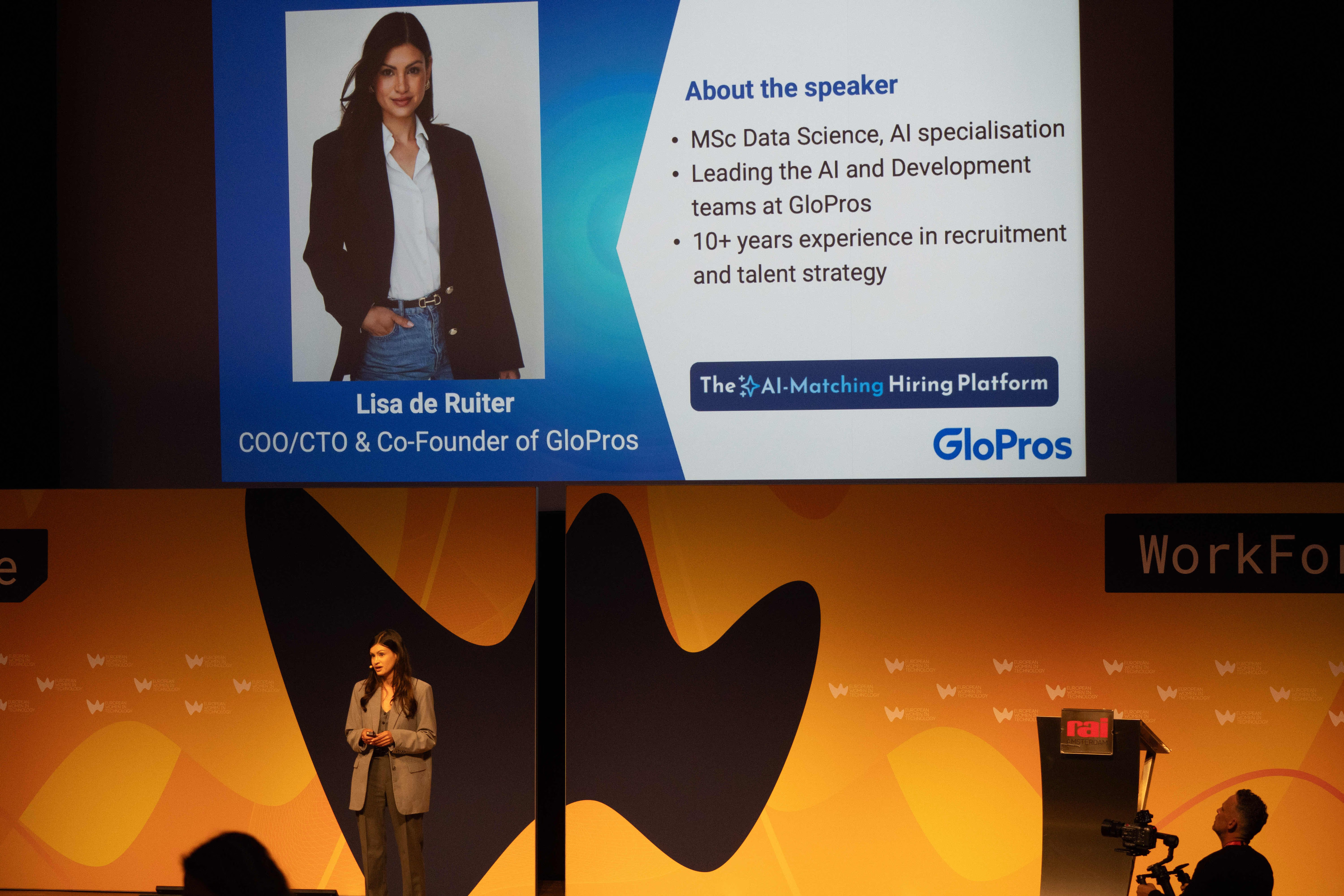
Lisa de Ruiter is Co-Founder and COO/CTO of GloPros, where she leads development of the AI models and search engine behind its recruitment and consulting platform. She brings more than ten years of recruitment experience, including seven as an international IT recruiter in Amsterdam, plus formal AI training: an MSc in Data Science (AI and machine learning) from Tilburg University and a Business Analytics program at MIT Sloan. That combination gives her both sides of the story this guide covers: recruitment and AI. Connect with Lisa on LinkedIn.
Most companies get the balance wrong. Some hand the whole process to software. Others keep everything manual and wonder why every role takes two months. This guide explains how AI recruitment, also called AI hiring, works when AI and humans each do the part they are good at.
I have worked on both sides of that balance. I spent seven years as an IT recruiter before I started building the AI models behind GloPros. I wrote this guide because the question hiring teams ask me most is not which software to buy. It is which parts of hiring AI should take over, and which parts it should never touch.
The guide starts with the basics and then covers what recruitment automation can take over. It shows where AI sourcing and AI screening see more than a recruiter, and where they see less. It also covers what the EU AI Act means for your HR team, realistic time-to-hire and cost-per-hire, and how to choose between AI recruitment tools, an agency or a recruitment service. Every section links to a deeper article where one exists.
1. What is AI recruitment?
AI recruitment is the use of artificial intelligence to run parts of the hiring process. It writes vacancies, sources and matches candidates, screens applications, schedules interviews and handles contracts. The AI does the repetitive work at speed. Recruiters keep the judgment: what the role needs, who fits, and the final decision.
How does AI recruitment work?
Every hire goes through the same steps, whether a person or software does the work. AI speeds up each one:
- Writing the vacancy. AI turns a short brief into a job description.
- Sourcing, or finding people. AI searches job boards, professional networks and databases for people with matching skills, including people who never applied.
- Matching, or comparing people to the role. AI weighs skills, experience, location and availability, and explains each ranking.
- Screening, or sorting applications. AI reads every CV against the same requirements and ranks them.
- Scheduling and admin. AI books interviews, sends reminders and prepares contracts.
You will also come across the term ATS, short for applicant tracking system. An ATS stores and organizes applications, like a filing cabinet. Many now include AI features, but an ATS on its own does not find anyone. Section 8 covers the tools in more detail.
What is the difference between AI in HR and AI in recruitment?
AI in HR covers the whole employee journey: onboarding, performance, learning and payroll. AI in recruitment is the part that focuses on hiring. It is where AI has moved fastest, because hiring produces a lot of structured data (vacancies, CVs, outcomes) and a lot of repetitive work.
Benefits and limitations of AI in recruitment
What AI does well
- Speed. Sourcing, screening and scheduling take hours, not weeks.
- Consistency. Every application is checked against the same criteria.
- Reach. It finds people across markets that nobody would find by hand.
Where AI falls short
- It only reads what is written down. It cannot see the reason behind a career change or a gap in a CV.
- It learns from the past. Trained on old hiring decisions, it can repeat old bias (section 6).
- It cannot judge fit. It does not know whether someone will work well with your team.
How AI hiring works: the AI + humans model
Put the two together and you get a clear division of labor. AI brings speed and scale. People bring judgment.
AI handles
People handle
Hand everything to software and you lose the judgment. Keep everything manual and every role takes months. Modern hiring uses each for what it does well, with people supervising the AI, as EU law requires for recruitment AI from December 2027 (section 6).
AI recruitment trends and statistics 2026
Three trends define 2026:
- From tools to process. Companies are redesigning how they hire around what AI can do, instead of adding an AI feature to the software they already have.
- Regulation has arrived. The EU AI Act treats recruitment AI as high-risk (section 6).
- A new buying question. Companies no longer ask "which software?" but "tools, agency or service?" (section 8).
Adoption is real but still early. SHRM's State of AI in HR 2026, a survey of 1,908 HR professionals, found that 39% of organizations use AI in HR, most often in recruiting (27%). Across the EU, 19.95% of enterprises with 10 or more employees used AI in 2025, rising to 33% in the Netherlands (Eurostat).
2. Recruitment automation: what can you automate, from job description to contract
Ask an HR team where their week goes and you hear something like this:
“250 applications to review. 12 hours of screening. 2 hours to create a single vacancy. 10 hours of admin before sourcing has even started.”
— Lisa de Ruiter, Co-Founder and COO/CTO, GloPros
Most of those hours go to repetitive work that AI can take over, so your team can spend them on the decisions. This section maps what you can automate across a whole hire, from the first brief to the signed contract, then looks closely at the first stage: writing the vacancy and getting it in front of the right people. Section 3 covers finding and matching people, and section 4 covers screening and interviews.
What is recruitment process automation?
Recruitment process automation is the use of automated tools to run the repeatable steps of hiring without manual work: posting, sourcing, screening, scheduling, assessment and contract generation. You can automate more than most teams expect, and less than most vendors claim. The table shows where the line sits at each step, in the order a hire runs.
Automation pays off fastest at the first and last steps of a hire. At the start, the vacancy: AI now drafts a clear job description in minutes. At the end, the admin: contracts, onboarding paperwork, payroll setup and, for freelancers and consultants, invoicing, timesheets and compliance in every country involved. This is where hiring quietly loses weeks, and because the work is rule-based, it is where automation is most reliable.
GloPros handles contracts, invoicing, payments and contractor payroll for every professional it delivers, in 24+ countries, so the admin never lands back on your desk. Section 10 explains how that works.
How is generative AI used in recruitment?
Generative AI uses the large language models behind ChatGPT and similar tools to write and rewrite text: job descriptions, outreach messages, interview questions, candidate summaries. It is the most visible form of AI in recruitment and the easiest to start with, because it needs no integration.
It is also the easiest to misuse. A generated job description that nobody edits sounds like every other generated job description. The vacancy is where you see most clearly how generative AI and a recruiter should split the work.
How to write and optimize job descriptions with AI
A well-written vacancy is the single cheapest improvement most companies can make. Generative AI drafts a clear, structured job description in minutes, and the better systems check it for jargon, unrealistic requirement lists and language that discourages qualified people from applying.
The recruiter's job shifts from writing to editing: is this actually the role, and does it sound like us?
Job description templates and examples
AI works better from a structure than from a blank page, so most teams start from a template: title, a one-paragraph summary of the role and why it exists, responsibilities, must-have and nice-to-have requirements, what the company offers, and how to apply.
Three mistakes repeat across templates, whether a person or AI fills them in: requirement lists longer than the responsibilities, internal job titles nobody searches for, and salary left out when the market expects it.
How does recruitment marketing automation work?
A finished vacancy still has to reach people. Recruitment marketing automation runs the outreach around it: posting to the right job boards and social channels, retargeting people who visited your careers page, and sending follow-up emails to professionals who showed interest but did not apply. It keeps a role visible without anyone scheduling every post by hand.
The recruiter decides the message and the audience. The automation handles the timing and the volume. It pays off most for roles you hire repeatedly, where the same audience needs to hear from you more than once.
AI recruitment examples and use cases
Put together, these are the use cases with a clear return today, in the order they appear in a hire:
- Writing and optimizing job descriptions
- Distributing vacancies and following up with interested professionals
- Sourcing specialist profiles across markets (section 3)
- Screening high-volume applications against fixed criteria (section 4)
- Instant interview scheduling
- Generating contracts and running contractor payroll (section 10)
The use case with the least clear return is predicting personality or performance from video or voice (section 4).
3. AI sourcing and AI matching: candidates you would never find yourself
For most hard-to-fill roles, the person you want already has a job and is not reading job boards. Posting a vacancy and waiting will not reach them. Sourcing goes out and finds them. Matching decides which of them are worth your time.
How does AI candidate sourcing work?
AI candidate sourcing is the automated search for professionals who match a role across databases, networks and job platforms, including people who have not applied.
It searches every market you hire in at once and finds professionals whose skills match your role even when their job title does not: the "data engineer" who is actually doing platform architecture, the SAP consultant listed under a project name rather than a module, the specialist in another country who never saw your vacancy.
GloPros sources across multiple channels at the same time and keeps a curated database of professionals who have already been screened. Active headhunting, not just posting.
“By the time we finished the intake call, the job description had been written and posted, and three SAP FICO consultants had already been surfaced: two silver medalists from previous searches and one newly found on LinkedIn. Each got a personalised message, our recruiter called all three, and we had a qualified shortlist in under 24 hours.”
— Aurelien Arnoux, Head of Recruitment, GloPros.
How does AI candidate matching work?
AI candidate matching compares a full candidate profile against a full role (skills, experience, seniority, availability, location and contract type), weighted for what matters in this vacancy, then ranks the results and explains the ranking. It ranks everyone in your process the same way, whether they were sourced or applied. Matching is the step that decides whether you get a long list or a short one.
At GloPros, AI matching runs on anonymized profiles. Name, photo, age and other personal details are hidden until the skills match has been made, so the first decision is about what someone can do, not who they appear to be. The AI-platform proposes; a recruiter checks every match before you see it.
Our matching accuracy is 96%.
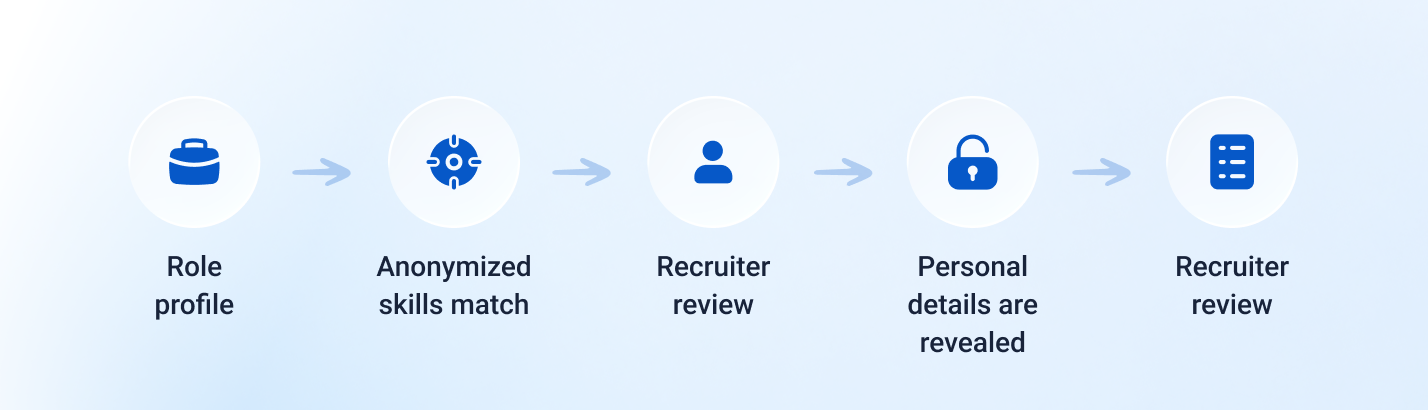
The practical result is fewer CVs on your desk and a higher share of them worth an interview. Reading those profiles in detail, and assessing the people behind them, is screening.
4. AI screening and AI interviews: what AI sees and what it misses
Matching tells you who is worth a look. Screening checks each of them in detail against your must-haves. Once people are in your process, whether they applied or were sourced, AI can read and assess every one of them in the same way. This is where AI is most consistent, and where its blind spots matter most.
How does AI CV and candidate screening work?
AI CV screening, also called resume screening, reads every application against the same criteria, in the same way, at the same speed. It picks up specific skills described in different words, spots a qualification buried in the third paragraph, and applies your must-haves consistently. For roles that attract hundreds of applications, this alone changes the recruiter's week.
Well-designed systems also explain themselves: this candidate ranks high because of these three matches, and low because this requirement is missing. Good systems also keep candidates engaged, answering questions around the clock and confirming next steps, so qualified people do not drop out while they wait to hear back.
What AI screening misses is everything that is not on paper: that the gap year was caring for a parent, that the career change was a considered decision, that the candidate with an unconventional background will be the strongest person in the room. It cannot tell you whether someone will work well with your team lead. Those are judgment calls, and they are the reason a recruiter reviews every shortlist at GloPros before it reaches you.
Screening only works on the people already in your process. For hard-to-fill roles, that is why sourcing comes first (section 3).
Are AI interviews and assessments reliable?
AI assessment covers video interviews scored by AI, game-based assessments and automated coding or skills tests. The category is growing fast, and the evidence is mixed.
Standardized skills tests, scored consistently, are useful and defensible: they measure something the role needs, and every candidate takes the same test. Systems that claim to read personality or trustworthiness from facial expressions or voice are not.
A practical rule: use AI assessment to measure what can be measured, and keep the interview a conversation between people.
5. Will AI replace recruiters?
No. AI will not replace recruiters. It replaces the volume work in recruiting: searching databases, sorting applications, scheduling interviews and handling admin. Recruiters keep the work that requires judgment: defining what a role needs, assessing fit, negotiating, closing and owning the result.
What AI takes over
- Sourcing across databases, networks and job platforms
- Screening and ranking applications against fixed criteria
- Interview scheduling and reminders
- Contracts, invoicing and payroll admin
We're not building GloPros to replace TA teams or cut hiring managers out of the process. We're building hiring workflows that take the repetitive manual work off their plate: sourcing, the screening backlog, the follow-up emails that pile up after every interview so the people doing the hiring can spend their time where it actually counts: meeting candidates face to face, building real relationships, and knowing who's the right fit beyond what's on a resume.
— Lisa de Ruiter, Co-Founder and COO/CTO, GloPros
Autopilot vs. copilot: how AI is changing recruitment
Companies put AI into hiring in two ways. In the copilot model, the recruiter does the work and AI suggests. In the autopilot model, AI runs the process and the recruiter steps in at the decisions that matter: the shortlist, the interview, the offer.
GloPros runs on autopilot. The AI-platform drives sourcing, matching, screening and scheduling. A dedicated recruiter reviews every match, briefs you, and stays with you until the hire is made and beyond.
You get the speed of the machine and the judgment of a person, and you never have to choose between them. The recruiter's job title has not changed. The job has: less of the week on administration, more of it on conversations.
What are AI recruiters and AI agents?
An AI recruiter is a product label, usually for a system that combines sourcing, matching and first contact in one workflow. Read what the system actually does before you trust the name.
An AI agent goes further: it is given a goal (fill this role) and takes a sequence of actions toward it, with a human checking in at set points. In practice, an AI agent is the autopilot model described above. This is where the category is heading, and it is the model GloPros builds on: autopilot for the process, with people at every decision that matters.
What stays human: judgment, relationship, culture fit
- Judgment. The hiring manager's brief says "five years of experience" but means "someone who can be left alone with the problem." Recognizing that the strongest candidate on paper is the wrong one for this team, or that the unusual profile is the right one.
- Relationship. Convincing someone who was not looking to take a call. Understanding what would make them move. Handling the counteroffer. Telling a candidate they did not get it in a way that makes them apply again next year.
- Culture fit and context. Knowing the company, the team and the manager well enough to say "this person will work here" with some confidence. This improves the longer a recruiter works with you.
- Accountability. Someone has to own the result. Software does not pick up the phone when a hire falls through in week two.
6. AI bias, ethics and the EU AI Act
AI in hiring raises two questions: is it fair, and is it legal? This section answers both.
AI bias in hiring: does AI reduce it or automate it?
Both are possible. The outcome depends on how the system is built and supervised. An AI system learns from data. Trained on ten years of hiring decisions made by people, it learns those people's preferences, including the ones they never noticed, and a system that ranks candidates like the ones you hired before will keep hiring the people you hired before.
One of the most cited cases was the recruiting tool Amazon abandoned in 2018 after it learned to downgrade CVs that included the word "women's". The AI did not invent the bias. It reproduced one.
The same mechanism works the other way. A system built to match on skills, with personal details hidden, tested for unequal outcomes between groups and supervised by a person, is more consistent than any individual recruiter. Consistency is the first requirement of fairness.
EU AI Act: recruitment is high-risk AI
The EU AI Act classifies AI systems used for recruitment and selection as high-risk. That covers systems that place targeted job advertisements, analyze and filter applications and evaluate candidates, as well as systems used for decisions on terms of employment, promotion or termination, task allocation based on individual behavior or personal traits, and performance monitoring.
High-risk means obligations on both sides. The provider of the system must meet requirements such as risk management, data governance, technical documentation and record-keeping. The employer using it must follow the provider's instructions, assign human oversight, keep the system's logs for at least six months, and inform workers’ representatives and affected workers before the system is used. Candidates must also be told when the system is used to make or support decisions about them.
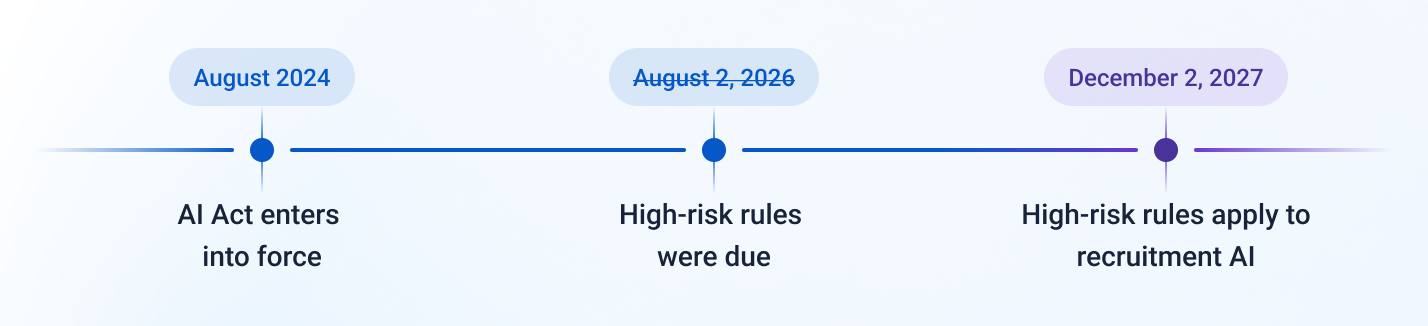
The timeline has moved. The high-risk obligations were set to apply from August 2, 2026. The Digital Omnibus on AI (Regulation (EU) 2026/1744), published in the Official Journal in July 2026, defers them to December 2, 2027.
"December 2027 is when employers must prove, not promise. Inventory every tool that ranks or filters candidates, keep its logs, and make sure a trained recruiter can overrule any score and that every rejection is a human's. At GloPros, names and photos are stripped before anything is scored, every score shows its reasons, and the model never rejects anyone."
— Reinis Nudiens, Head of Data & AI, GloPros
How bias-free, skills-based hiring works
Three practices make the difference:
- Anonymize before you match. Hide name, photo, age, gender and address until the skills comparison is done. This is how AI matching works at GloPros: the first decision is about skills and experience, and personal details appear only after the match.
- Match on skills, not proxies. A degree from a particular university, a gap in the CV, a previous employer's brand: these are proxies, and weak ones. Skills-based hiring compares what the role needs with what the person has done.
- Keep a person in the loop, and make the loop visible. Every shortlist at GloPros is reviewed by a recruiter before it reaches you, and you can see how the process ran. The AI Act requires employers using high-risk AI to assign human oversight to people with the necessary competence, training and authority.
7. Results: time-to-hire and cost-per-hire benchmarks
Two numbers show whether hiring works: how long it takes and what it costs. This section gives the benchmarks for both.
Time-to-hire: benchmarks and how to reduce it
Time-to-fill runs from the day a vacancy is approved to the day an offer is accepted. Time-to-hire runs from the day a candidate enters your process to the day they accept. Time-to-fill measures your whole hiring machine; time-to-hire measures how fast you move once you have found someone. The two are mixed up constantly. Benchmark against the right one.
SHRM's 2026 Recruiting Executives Benchmarking, based on data from more than 4,600 organizations, puts the median time-to-fill for non-executive roles at 39 calendar days. No comparable European benchmark exists, but hiring pressure is higher in the Netherlands: in the second quarter of 2026 it had the highest job vacancy rate in the EU, 4.1% against an EU average of 2.0% (Eurostat).
The largest delays are usually not in the search. They are in the gaps: waiting for the hiring manager to review CVs, finding an interview slot that works for four calendars, waiting for feedback, drafting the contract. AI removes the gaps it can remove (instant scheduling, immediate screening, contracts generated the same day) and makes the remaining ones visible so they can be managed.
Cost-per-hire: formula, benchmarks and calculator
Cost-per-hire is the total internal and external cost of recruiting, divided by the number of hires in the period. Internal costs include recruiter time, hiring manager time, tools and employer branding. External costs include agency fees, job board spend and assessments.
Internal costs
External costs
SHRM's 2026 Recruiting Executives Benchmarking, based on data from more than 4,600 organizations, puts the median cost-per-hire at $1,300 for non-executive roles and $15,000 for executives.
Two things matter more than the headline number. Most companies undercount it, because hiring manager time is rarely tracked. And the cost of the vacancy itself, the work not done while the role is open, can exceed the cost of filling it. That is why speed and cost are the same conversation: a process that fills roles in days rather than weeks also costs less, because the vacancy cost stops accruing.
At GloPros you pay when a placement succeeds. No retainer, no subscription, no upfront cost. If the role is not filled, there is no fee.
8. AI recruitment tools, ATS or a recruitment service?
Every growing company asks the same question: do we buy recruitment software, brief an agency, or find a partner who runs the process for us? This section compares all three routes.
Do you need an ATS (applicant tracking system)?
Start with the software question. An applicant tracking system (ATS) stores, organizes and tracks applications. If you hire fewer than a handful of people a year, you probably do not need one; a structured process and a shared inbox will do. If you hire regularly, an ATS keeps you organized and compliant, and most now add AI features for screening and ranking.
But an ATS is a filing system for applications. It does not find anyone, and it does not fill the role.
AI recruitment tools and software: the landscape
AI recruitment tools come in layers: the ATS as the system of record, sourcing tools that search external databases, screening and ranking tools, scheduling assistants, assessment platforms, and generative AI for writing. Recruitment automation tools in the middle layers do the most work and need the most integration. You license them, integrate them and run the process with your own team.
Works well when: you have an in-house recruitment team with capacity, hire the same profiles repeatedly, and want full control of the process and the data.
Watch out for: integration work (recruitment software that does not talk to other recruitment software), the time it takes to configure and learn each system, and the fact that a tool finds and sorts but does not call anyone. You still need recruiters, and you still pay for the software whether or not you hire.
What is a recruitment chatbot?
A recruitment chatbot answers candidate questions on your careers page or in a messaging app, around the clock: location, salary range, next steps, application status. The more capable ones also collect first screening answers and book interviews.
Works well when: you hire for high-volume roles, where the same questions arrive every day.
Watch out for: it answers questions, but it does not source, match or decide. It is one tool in the stack, not AI recruitment itself (section 1).
What does a recruitment agency cost?
A recruitment or staffing agency searches, screens and presents a shortlist for a fee, typically a percentage of the first-year salary per placement.
Works well when: you need one specialist role filled and have no internal capacity.
Watch out for: fee structures that are hard to compare, limited visibility into how the search is run, and the need to re-brief every new agency contact. Many agencies work on a no-cure-no-pay basis, so ask what "cure" means in the contract.
Tools vs. agency vs. service: an honest comparison
The third route is a recruitment service that runs on an AI-platform. You brief once. The service runs sourcing, matching, screening and scheduling on its platform, a dedicated recruiter reviews every match and stays your point of contact, and the same partner handles contracts, payroll and admin for permanent hires, freelancers and consultants, in every country you hire in.
Works well when: you want the speed and consistency of the technology without building and running the stack yourself, hire across roles, contract types or countries, and want one accountable partner rather than a vendor per market.
Watch out for: make sure you can see the process. You should know where a search stands, who has been approached, and why a shortlist looks the way it does.
This is the model GloPros runs. Recruitment & Consulting services, powered by an AI-platform. You brief, you interview, you hire. The platform shows everything, and the recruiter is one call away. You pay when the placement succeeds. The recruitment services page explains how a hire runs from brief to signed contract.
At GloPros we've made it simple: the AI does the searching and the screening, our team stays close, and the only thing left on your desk is the decision.
— Lisa de Ruiter, Co-Founder and COO/CTO, GloPros
If you are still not sure which route fits, a short conversation usually settles it.
9. Modern recruitment strategies: how to implement AI in recruitment
By now you know what AI recruitment does, where it falls short, what the law asks and what it costs. This section covers where to start.
What are modern recruitment strategies?
Modern recruitment strategies are built around three shifts, and AI is what makes each one practical at scale:
- From inbound to outbound. Most of the people you want already have a job and are not applying, so sourcing replaces waiting (section 3).
- From credentials to skills. What someone has done matters more than where they studied (section 6).
- From one hiring route to several. Permanent hires, freelancers and consultants, chosen per role rather than by habit (section 10).
How to implement AI in recruitment
Six steps, in order:
- Start with the step that costs your team the most hours, not the most impressive feature. For most companies that is screening or scheduling.
- Define the criteria before you automate them. AI applies whatever you give it, consistently.
- Run the AI alongside the current process for a few weeks and compare shortlists.
- Keep a person reviewing every output until the results earn trust.
- After that, keep a person reviewing the outputs that matter: the shortlist, the rejection, the offer.
- Keep the provider's instructions and the system's logs. The EU AI Act will ask for both (section 6).
If you would rather not build this yourself, a recruitment service runs these steps for you (section 8).
10. Outsourcing recruitment, RPO and RaaS: payroll, MSP and consulting
Hiring does not stop at the signature: the people you hire need contracts, payroll and compliance. This section covers outsourcing the search itself, and the services around the hire.
What is outsourcing recruitment?
Outsourcing recruitment means handing the search, or the whole recruitment function, to an external partner. It ranges from a single hard-to-fill role to a standing arrangement where the partner runs all your hiring. Companies outsource recruitment for four reasons: no internal recruitment team, more open roles than the team can carry, hiring in countries where they have no presence, or roles so specialist that generalist searching keeps missing.
What is Recruitment-as-a-Service, and how does it differ from RPO?
Recruitment process outsourcing (RPO) is an arrangement in which a provider takes over part or all of a company's recruitment process, usually under a longer contract with committed volume. Recruitment-as-a-Service (RaaS) is the more flexible form of recruitment process outsourcing: you use the service when you need it, per role or per period, without committing to a function-wide contract.
The service model GloPros runs is closest to RaaS: brief a role when you have one, work with the same recruiter and the same platform each time, and pay per successful placement.
Contractor payroll and compliance: how zero admin works
Every professional you hire must be paid correctly, in the right country, under the right contract. For permanent hires this is your payroll. For freelancers and consultants it means contracts, timesheets, invoicing, payments and compliance with local rules on classification (whether someone counts as self-employed or an employee), which differ by country and change often.
This is the admin that quietly eats HR capacity, and the one most companies are happiest to hand over. GloPros handles contracts, invoicing, payments and contractor payroll for every professional it delivers, so the work is done once and correctly. The HR & Payroll page covers the operational HR services that wrap around every hire.
What is an MSP, and when do you need one?
Once a company has more than a handful of freelancers and consultants, across more than one department or country, nobody has the full picture: who is working where, on what contract, at what rate, until when. A managed service provider (MSP) centralizes that: one view of the external workforce, one set of contracts, compliance handled. GloPros delivers this as MSP, one of its four services.
When do you need recruitment consulting?
Some roles are not hires at all. A migration to SAP S/4HANA, a finance transformation, a six-month gap in a leadership team: what you need is senior expertise for a defined period. GloPros Consulting delivers specialists for critical projects, freelance or as a consultant, with contracts and payroll handled.
Why one partner for recruitment, payroll and MSP
The recruitment, the contract, the payroll, the external workforce overview and the specialist for the project all draw on the same platform and the same team. You brief once, you have one point of contact, and nothing is lost between vendors. Recruitment, Consulting, MSP and HR, all powered by our AI-platform.
GloPros has been our preferred recruitment and managed service provider for many years. What I really like is their dedication. And with their platform they deliver us full services support for our interim and permanent positions.
— Paul John Bakker, Co-CIO, ASICS
11. Frequently asked questions
How many companies use AI in recruitment?
According to SHRM’s State of AI in HR 2026, a survey of 1,908 HR professionals, 39% of organizations use AI in HR, most often in recruiting (27%).
Is AI recruitment allowed under the EU AI Act?
Yes, with obligations. The EU AI Act classifies AI used for recruitment and selection as high-risk. Employers using it must assign human oversight, inform candidates and workers that AI is used, follow the provider's instructions and keep system logs. These obligations apply from December 2, 2027, following the Digital Omnibus on AI.
Does AI reduce bias in hiring?
It can, if it is built for it. Matching on anonymized profiles, comparing skills rather than proxies, testing for unequal outcomes between groups and keeping a person in the loop make AI more consistent than manual screening. AI trained uncritically on past hiring decisions reproduces the bias in those decisions.
What is the difference between an ATS and AI recruitment?
An applicant tracking system stores and organizes applications that come to you. AI recruitment acts on the process: it sources people who did not apply, matches and ranks them, screens, schedules and handles contracts. Many ATS products add AI features, but the system remains built around inbound applications.
Which AI is best for recruitment?
The best AI for recruitment depends on the step you want to improve: sourcing tools find people, screening tools rank applications, scheduling assistants book interviews and generative AI writes vacancies. Most companies combine several, or work with a recruitment service that runs them together on one AI-platform.
How do I start using AI in recruitment?
Start with the step that costs your team the most hours, usually screening or scheduling. Define your criteria first, run the AI alongside your current process for a few weeks, and keep a person reviewing the shortlist, the rejection and the offer.
What does a recruitment service cost?
It depends on the model. Recruitment software is licensed whether or not you hire. Agencies typically charge a percentage of first-year salary per placement.
GloPros charges per successful placement, with no retainer, subscription or upfront cost.
How fast can a role be filled with AI recruitment?
Sourcing, matching and first-round screening that used to take weeks now happen in days, and interviews are scheduled instantly. The remaining time is mostly yours: reviewing the shortlist, interviewing and deciding.
GloPros fills roles in days.
Can I outsource recruitment for one role only?
Yes. Recruitment-as-a-Service works per role: you brief a vacancy when you have one, the service runs the search on its AI-platform with a dedicated recruiter, and you pay when the placement succeeds. You do not have to outsource your whole recruitment function.
GloPros is a Recruitment & Consulting company, powered by an AI-platform. Companies come to us when they need highly skilled global professionals, delivered as permanent hires, freelancers or consultants, in 24+ countries.